


商品详情
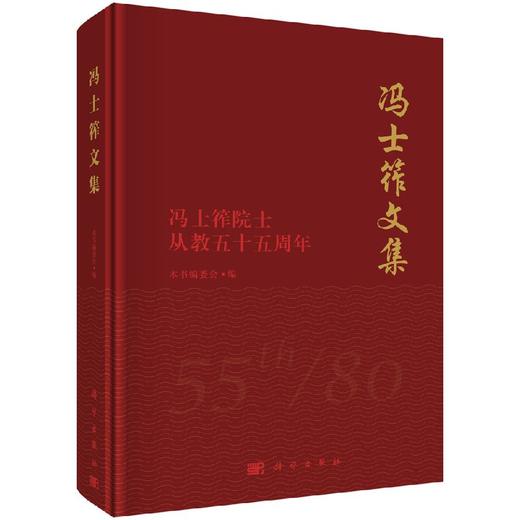
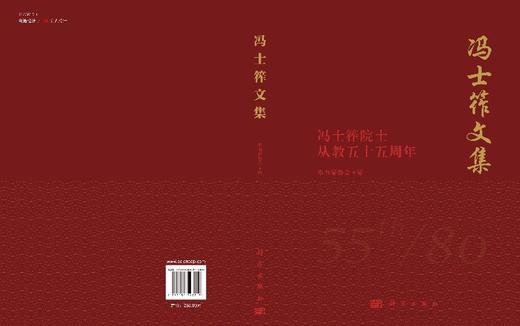
书名:冯士筰文集——冯士筰院士从教五十五周年
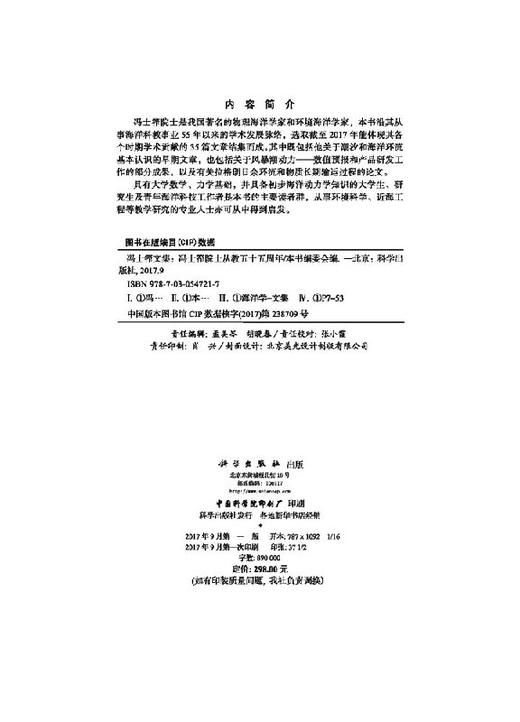
定价:298.0
ISBN:9787030547217
作者:本书编委会
版次:1
出版时间:2017-10
内容提要:
冯士筰院士是我国著名的物理海洋学家和环境海洋学家,本书沿其从事海洋科教事业55年以来的学术发展脉络,选取截至2017年能体现其各个时期学术贡献的35篇文章结集而成。其中既包括他关于潮汐和海洋环流基本认识的早期文章,也包括关于风暴潮动力——数值预报和产品研发工作的部分成果,以及有关拉格朗日余环流和物质长期输运过程的论文。
目录:
目录
编者的话
序
前言
A Preliminary Study on the Mechanism of Shallow Water Storm Surges 1
Chin Tseng-Hao (秦曾灏) and Feng Shih-Zao (冯士筰)
A Three-dimensional Nonlinear Model of Tides 22
Feng Shih-Zao (冯士筰)
大洋风生 –热盐环流模型 33
冯士筰
F-平面上的宽陆架诱导阻尼波 48
冯士筰
超浅海风暴潮的数值模拟(一)——零阶模型对渤海风潮的初步应用 62
孙文心,冯士筰,秦曾灏
常底坡有限宽陆架诱导阻尼波的一种模型 77
冯士筰
论f-和β-坐标系 86
冯士筰
论大洋环流的尺度分析及风旋度 .热盐梯度方程式 96
冯士筰
The Baroclinic Residual Circulation in Shallow Seas I. The Hydrodynamic Models 107
Feng Shizuo, Xi Pangen and Zhang Shuzhen
A Three-dimensional Nonlinear Hydrodynamic Model with Variable Eddy Viscosity in Shallow Seas 119
Feng Shizuo
On Lagrangian Residual Ellipse 132
R.T. Cheng, Shizuo Feng, Pangen Xi
On Tide-induced Lagrangian Residual Current and Residual Transport 1. Lagrangian Residual Current 145
Shizuo Feng, Ralph T. Cheng, Pangen Xi
On Tide-induced Lagrangian Residual Current and Residual Transport 2. Residual Transport with Application in South San Francisco Bay, California 170
Shizuo Feng, Ralph T. Cheng, Pangen Xi
A Three-dimensional Weakly Nonlinear Dynamics on Tide-induced Lagrangian Residual Current and Mass-transport 193
Feng Shizuo (冯士筰)
A Three-dimensional Weakly Nonlinear Model of Tide-induced Lagrangian Residual Current and Mass-transport, with an Application to the Bohai Sea 211
Shizuo Feng
Lagrangian Residual Current and Long-term Transport Processes in a Weakly Nonlinear Baroclinic System 229
Feng Shizuo, Ralph T. Cheng, Sun Wenxin, Xi Pangen and Song Lina
On the Lagrangian Residual Velocity and the Mass-transport in a Multi- frequency Oscillatory System 246
Shizuo Feng
The Dynamics on Tidal Generation of Residual Vorticity 261
Feng Shi-zuo (冯士筰)
第九章浅海环流物理及数值模拟 265
冯士筰
A Turbulent Closure Model of Coastal Circulation 308
Feng Shi-Zuo (冯士筰) and Lu You-Yu (鹿有余)
A Three-dimensional Numerical Calculation of the Wind-driven Thermohaline and Tide-induced Lagrangian Residual Current in the Bohai Sea 313
Wang Hui, Su Zhiqing, Feng Shizuo and Sun Wenxin
An Inter-tidal Transport Equation Coupled with Turbulent K-. Model in a Tidal and Quasi-steady Current System 327
Feng Shizuo (冯士筰) and Wu Dexing (吴德星)
On Circulation in Bohai Sea Yellow Sea and East China Sea 331
Shizuo Feng
Modelling Annual Cycles of Primary Production in Different Regions of the Bohai Sea 355
Huiwang Gao, Shizuo Feng and Yuping Guan
湍流局地平衡假设的新推论——齐次湍流动能输运方程封闭模型与应用(Ⅱ) 366
魏皓,冯士筰,武建平,张平
Variability of the Bohai Sea Circulation Based on Model Calculations 373
Dagmar Hainbucher, Hao Wei, Thomas Pohlmann, Jürgen Sündermann, Shizuo Feng Analysis and Modelling of the Bohai Sea Ecosystem—a Joint German- Chinese Study 395
Jürgen Sündermann, Shizuo Feng
Tidal-induced Lagrangian and Eulerian Mean Circulation in the Bohai Sea 413
Hao Wei, Dagmar Hainbucher, Thomas Pohlmann, Shizuo Feng, Jürgen Sündermann A Lagrangian Mean Theory on Coastal Sea Circulation with Inter-tidal Transports I. Fundamentals 425
Feng Shizuo, Ju Lian, Jiang Wensheng
A Lagrangian Mean Theory on Coastal Sea Circulation with Inter-tidal Transports II. Numerical Experiments 445
Ju Lian, Jiang Wensheng, Feng Shizuo
Analytical Solution for the Tidally Induced Lagrangian Residual Current in a Narrow Bay 463
Wensheng Jiang, Shizuo Feng
Simulation of the Lagrangian Tide-induced Residual Velocity in a Tide- dominated Coastal System: A Case Study of Jiaozhou Bay, China 491
Guangliang Liu, Zhe Liu, Huiwang Gao, Zengxiang Gao and Shizuo Feng
Acquisition of the Tide-induced Lagrangian Residual Current Field by the PIV Technique in the Laboratory 512
Tao Wang, Wensheng Jiang, Xu Chen, and Shizuo Feng
3D Analytical Solution to the Tidally Induced Lagrangian Residual Current Equations in a Narrow Bay 526
Wensheng Jiang, Shizuo Feng
Numerical Study on Inter-tidal Transports in Coastal Seas 557
Mao Xinyan, Jiang Wensheng, Zhang Ping, and Feng Shizuo
附录:冯士筰院士学术著作列表 574
在线试读:
A Preliminary Study on the Mechanism of Shallow Water Storm Surges*
Chin Tseng-Hao (秦曾灏) and Feng Shih-Zao (冯士筰)
I. Introduction
The so-called "whole current method" (or "total transport method") has been prevalent in the theoretical study of storm surges for a long time. The storm surges as a three-dimensional problem can be transformed into a two-dimensional one by means of this method, hence the mathematical analysis is simplified. The solution of the storm-induced current thus obtained does not, however, yield its vertical distribution. Besides this, the method embodies another shortcoming, i.e., some subjective assumptions[1(5] have to be introduced by many authors in order to keep the governing equations in a closed form. Some of them have devoted themselves to the study of the bottom stress[6]. Hence it complicates the problem.
It is evident that some real dynamical mechanism about storm surges could not be revealed, at least, by the "whole current method", as discussed in Section V of this paper. To investigate directly the three-dimensional storm surges instead of using the "whole current method" seems more reasonable. Moreover, it is necessary for both theoretical and practical purposes. A preliminary attempt has been made early by Welander[7] to approach this problem. A numerical method has been suggested lately by Heaps[8] for computing the three-dimensional time-dependent wind-induced current structure, in addition to sea level elevations. A tentative scheme has been carried out in a closed rectangular basin with uniform wind. In this paper, an effort is made to investigate analytically the three-dimensional shallow water storm surges by the fundamental hydrodynamical equations. The theory of shallow water surge is subdivided into two parts, namely, the ordinary shallow water theory and the ultra-shallow water theory. The dynamical criteria of the classification are given. An exact solution of the storm-induced current and the corresponding equation of the storm-induced sea level elevation for the ultra-shallow sea are obtained. As an example, the authors give and then analyze these exact solutions for sea areas of uniform depth on the continental shelf with constant coefficient of eddy viscosity.
It is quite an important subject to reveal the mechanism of storm surges as a theoretical basis for numerical analysis and prediction of storm surges.
Rossby[9] was notably the first who had proposed the concept about geostrophic adaptation between the pressure field and the velocity distribution in the ocean. A series of investigations on the problem of the adaptation have been successively made with reference to various scales of atmospheric motion since 1938. The preliminary analysis shows that the adaptation and the evolution also existed for the ultra-shallow water storm surges. The distinction between the adaptation and evolution, as well as their physical meanings, is discussed for the ultra-shallow sea, say, the Pohai Sea, in order to offer a key to further studies on the mechanism of storm surges.
II. The Governing Equations and the Determination of Characteristic Parameters
The basic equations governing the shallow water storm surges may, with good approximation, be expressed as
(1)
(2)
In these equations t denotes the time, z the vertical coordinate,the unit vector along z-axis pointing upward,the horizontal Del operator,the horizontal divergence operator,the two-dimensional Laplace operator, q, w the horizontal velocity vector and vertical component of current velocity, respectively, ( the storm-induced elevation of the sea surface, pa the surface atmospheric pressure, f the Coriolis parameter, ( the density of sea water, g the acceleration of the earth's gravity, , the kinematic coefficients of vertical and lateral eddy viscosity, respectively.
Here, f, ( and g are assumed to be constants. The boundary conditions have to be specified at the surface and the bottom. The surface conditions require that
(3)
(4)
at; the bottom conditions may be taken as
(5)
at; where h denotes the depth, the wind stress vector at the sea surface.
The wind stress is usually the main forcing function when the severe storm surges have been developed over shallow waters[1]. Therefore, it seems reasonable to assume under the action of the wind stresson the surface, as given by Equation (3) .
By introducing the following dimensionless variables:in which L is the characteristic horizontal scale, the characteristic value of the depth and are the corresponding characteristic values, Eqs. (1), (2) and (3)((5) may then be written in the dimensionless form as follows:
(1)
(2)
with the boundary conditions:
(3)
(4)
at; and
(5)
at, where
Although the physical meaning of foregoing dimensionless variables is evident, it seems necessary to elucidate with emphasis two points as follows.
Firstly, the storm surge appears oscillatory. For example, the whole body of water oscillates usually in a closed sea, a semi-closed sea, a bay or over the continental shelf-seiches. The inertial oscillations are gradually damped out by the eddy viscosity of water.
The dimensionless parameteris a measure of the inertial effect in storm surges, i.e.gives the criteria measuring the relative magnitude of the effect of inertial oscillation in storm surges. Actually, the above reasoning is obvious, becauseandare respectively in proportion to the characteristic frequencies of the water and the coefficient of eddy viscosity. The magnitude ofis proportional to, and it may be expected that the effect of inertial oscillation is negligible in the zero-order model of shallow water surge as the depth diminishes to a certain threshold value. A vivid physical picture would be drawn with further discussion of the characteristic periodof the surge and the criteriatogether.
At certain instant, if the oscillations are excited in a storm surge such that the order of magnitude of , i.e.,is unity at least, then the characteristic period shows that the greater is, i.e., the greater the frequency of the excited oscillations is, the less will result. Moreover, the greater the wind stress and the smaller are, the smaller would be; this implies that the excited oscillations are damped out more quickly by the eddy viscosity. In a shallow sea with small depth such as the Pohai Sea, it may generally be expected that the excited initial oscillations in a storm surge under the action of strong wind, no matter how severe their intensities are, will be dissipated by the eddy vis cosity in a short time. In fact, if assuming at least for the Pohai Sea, the duration of decay for the above-mentioned oscillations under typically strong winds will be less than several hours. Obviously, this is comparatively smaller than several days-the duration of surge process for the Pohai Sea.
Secondly, the dangerous surges develop in very shallow sea and cause the catastrophe there, therefore the nonlinear effects become a specially important problem. Unfortunately, studies on the nonlinear problem have not yet been sufficient and efficient because of mathematical difficulties. There are two nonlinear dimensionless parameters ( and ( involved in the foregoing system of Eqs. (1)(((2)( and (3)(((5)(, which are physically different in essence. The parameterrepresents nonlinear effect of convective acceleration comprised partially in the inertial terms of the equation of motion, while the parameter ( defined by the ratio of the characteristic amplitude of the surge to the characteristic depth implies the nonlinear mutual interaction between the storm-induced currents and the variations of sea surface elevations. In general,andare unequal, so these nonlinear effects should be treated separately. Especially, in the case of very shallow waters such as the Pohai Sea, ( has to be introduced under certain order of approximation in which might be well neglected. This is due to the fact thatis subjected to the severe damping effect of eddy viscosity within the whole sea so that would not attain the same order of magnitude as. The equalityholds only whenequals to unity. Consequently,andare distinct in dynamically nonlinear character and a proposal for subdivision of the theory of shallow water surge into two parts is suggested: the ordinary shallow water surge theory which satisfies the dynamic conditionor its equivalence, and the ultra-shallow water theory which satisfies the dynamic conditionor its equivalence .
In the case of ultra-shallow waters as the Pohai Sea, the foregoing dimensionless variables under the surface wind stress ranging from 10.5(22.0 (C.G.S.) (corresponding to the surface wind speed from 18 m/s to 26 m/s) amount to①=10(1;=10(1; = 10(2;=1;= 10(2;=10(2 (corresponding to=107).
The previous dynamic condition for the ultra-shallow sea is obviously satisfied, hence studies on the storm surges occurring in the Pohai Sea belong to the category of the ultra- shallow water theory. The exclusion of inertial oscillations in the zero-order dynamic model is an important characteristic of the ultra-shallow water surges. The zero-order model for the ultra-shallow sea, say, the Pohai Sea, is a linear quasi-equilibrium one in which the horizontal pressure-gradient force expressed as the surface slope is approximately balanced by the horizontal Coriolis force and the horizontal frictional force due to the vertical turbulent transfer (the inertial force can be neglected in the first approximation). As to the first-order model, the equations of motion contain also the time derivative terms and the -nonlinear effect in addition to those terms contained in the zero-order model, but the -nonlinear effect can be dropped in this model. This is an important characteristic for the ultra-shallow water surges. Thus the previous subdivision of the theory of shallow water surge not only becomes necessary theoretically, but also provides a convenient approach to the problem of ultra-shallow water surges.
It is noteworthy that the nonlinear effect may also be caused by the nonlinear coefficient of eddy viscosity.
Finally, we give the order of magnitude of terms involved in Eqs. (1) & (2) which have been omitted from Reynolds' equations (of incompressible fluid) in complete form. By inserting the typical values of previous variables for the Pohai Sea into the various terms, it is found that only Coriolis terms have the magnitude of 10(5, the rest of them are all less than 10(11. Hence the approximation of the system of Eqs. (1) & (2) to Reynolds' equations is valid with high accuracy. This is apparent because the characteristic depth is much smaller than the characteristic horizontal scale in a shallow sea.
III. The Zero-order Dynamic Model for the Ultra-shallow Water Storm Surges
1. General case
If the study on the ultra-shallow water surges is restricted to the sea area such as the Pohai Sea, the zero-order dynamic model may then be expressed mathematically as follows:
(6)
(7)
(8)
The boundary conditions require that
at surface z = 0:
(9)
(10)
at bottom :
(11)
along the coasts :
(12)
along the open sea boundary :either or (13)
The initial condition is
(14)
where x, y, z consist of right-handed Cartesian coordinate system,,,the corresponding current velocity components,,the two horizontal components of the eddy stress, ,the two direction-cosines of coastal normal, respectively, and M, N, as well as , are known functions.
The kinematic coefficient of eddy viscosity is assumed to be.
By introducing a complex velocity , an analytical solution of Eqs. (6) & (7) satisfying the boundary conditions (9) & (11) is easily given by[7]
(15)
(16)
Where。
The subscripts R and I denote respectively the real and the imaginary parts of a variable.
Integrating (8) with respect to z from bottom to surface and using (10) & (11), we get
(17)
where
Integrating (15) & (16) vertically and substituting the results into (17) lead to
定价:298.0
ISBN:9787030547217
作者:本书编委会
版次:1
出版时间:2017-10
内容提要:
冯士筰院士是我国著名的物理海洋学家和环境海洋学家,本书沿其从事海洋科教事业55年以来的学术发展脉络,选取截至2017年能体现其各个时期学术贡献的35篇文章结集而成。其中既包括他关于潮汐和海洋环流基本认识的早期文章,也包括关于风暴潮动力——数值预报和产品研发工作的部分成果,以及有关拉格朗日余环流和物质长期输运过程的论文。
目录:
目录
编者的话
序
前言
A Preliminary Study on the Mechanism of Shallow Water Storm Surges 1
Chin Tseng-Hao (秦曾灏) and Feng Shih-Zao (冯士筰)
A Three-dimensional Nonlinear Model of Tides 22
Feng Shih-Zao (冯士筰)
大洋风生 –热盐环流模型 33
冯士筰
F-平面上的宽陆架诱导阻尼波 48
冯士筰
超浅海风暴潮的数值模拟(一)——零阶模型对渤海风潮的初步应用 62
孙文心,冯士筰,秦曾灏
常底坡有限宽陆架诱导阻尼波的一种模型 77
冯士筰
论f-和β-坐标系 86
冯士筰
论大洋环流的尺度分析及风旋度 .热盐梯度方程式 96
冯士筰
The Baroclinic Residual Circulation in Shallow Seas I. The Hydrodynamic Models 107
Feng Shizuo, Xi Pangen and Zhang Shuzhen
A Three-dimensional Nonlinear Hydrodynamic Model with Variable Eddy Viscosity in Shallow Seas 119
Feng Shizuo
On Lagrangian Residual Ellipse 132
R.T. Cheng, Shizuo Feng, Pangen Xi
On Tide-induced Lagrangian Residual Current and Residual Transport 1. Lagrangian Residual Current 145
Shizuo Feng, Ralph T. Cheng, Pangen Xi
On Tide-induced Lagrangian Residual Current and Residual Transport 2. Residual Transport with Application in South San Francisco Bay, California 170
Shizuo Feng, Ralph T. Cheng, Pangen Xi
A Three-dimensional Weakly Nonlinear Dynamics on Tide-induced Lagrangian Residual Current and Mass-transport 193
Feng Shizuo (冯士筰)
A Three-dimensional Weakly Nonlinear Model of Tide-induced Lagrangian Residual Current and Mass-transport, with an Application to the Bohai Sea 211
Shizuo Feng
Lagrangian Residual Current and Long-term Transport Processes in a Weakly Nonlinear Baroclinic System 229
Feng Shizuo, Ralph T. Cheng, Sun Wenxin, Xi Pangen and Song Lina
On the Lagrangian Residual Velocity and the Mass-transport in a Multi- frequency Oscillatory System 246
Shizuo Feng
The Dynamics on Tidal Generation of Residual Vorticity 261
Feng Shi-zuo (冯士筰)
第九章浅海环流物理及数值模拟 265
冯士筰
A Turbulent Closure Model of Coastal Circulation 308
Feng Shi-Zuo (冯士筰) and Lu You-Yu (鹿有余)
A Three-dimensional Numerical Calculation of the Wind-driven Thermohaline and Tide-induced Lagrangian Residual Current in the Bohai Sea 313
Wang Hui, Su Zhiqing, Feng Shizuo and Sun Wenxin
An Inter-tidal Transport Equation Coupled with Turbulent K-. Model in a Tidal and Quasi-steady Current System 327
Feng Shizuo (冯士筰) and Wu Dexing (吴德星)
On Circulation in Bohai Sea Yellow Sea and East China Sea 331
Shizuo Feng
Modelling Annual Cycles of Primary Production in Different Regions of the Bohai Sea 355
Huiwang Gao, Shizuo Feng and Yuping Guan
湍流局地平衡假设的新推论——齐次湍流动能输运方程封闭模型与应用(Ⅱ) 366
魏皓,冯士筰,武建平,张平
Variability of the Bohai Sea Circulation Based on Model Calculations 373
Dagmar Hainbucher, Hao Wei, Thomas Pohlmann, Jürgen Sündermann, Shizuo Feng Analysis and Modelling of the Bohai Sea Ecosystem—a Joint German- Chinese Study 395
Jürgen Sündermann, Shizuo Feng
Tidal-induced Lagrangian and Eulerian Mean Circulation in the Bohai Sea 413
Hao Wei, Dagmar Hainbucher, Thomas Pohlmann, Shizuo Feng, Jürgen Sündermann A Lagrangian Mean Theory on Coastal Sea Circulation with Inter-tidal Transports I. Fundamentals 425
Feng Shizuo, Ju Lian, Jiang Wensheng
A Lagrangian Mean Theory on Coastal Sea Circulation with Inter-tidal Transports II. Numerical Experiments 445
Ju Lian, Jiang Wensheng, Feng Shizuo
Analytical Solution for the Tidally Induced Lagrangian Residual Current in a Narrow Bay 463
Wensheng Jiang, Shizuo Feng
Simulation of the Lagrangian Tide-induced Residual Velocity in a Tide- dominated Coastal System: A Case Study of Jiaozhou Bay, China 491
Guangliang Liu, Zhe Liu, Huiwang Gao, Zengxiang Gao and Shizuo Feng
Acquisition of the Tide-induced Lagrangian Residual Current Field by the PIV Technique in the Laboratory 512
Tao Wang, Wensheng Jiang, Xu Chen, and Shizuo Feng
3D Analytical Solution to the Tidally Induced Lagrangian Residual Current Equations in a Narrow Bay 526
Wensheng Jiang, Shizuo Feng
Numerical Study on Inter-tidal Transports in Coastal Seas 557
Mao Xinyan, Jiang Wensheng, Zhang Ping, and Feng Shizuo
附录:冯士筰院士学术著作列表 574
在线试读:
A Preliminary Study on the Mechanism of Shallow Water Storm Surges*
Chin Tseng-Hao (秦曾灏) and Feng Shih-Zao (冯士筰)
I. Introduction
The so-called "whole current method" (or "total transport method") has been prevalent in the theoretical study of storm surges for a long time. The storm surges as a three-dimensional problem can be transformed into a two-dimensional one by means of this method, hence the mathematical analysis is simplified. The solution of the storm-induced current thus obtained does not, however, yield its vertical distribution. Besides this, the method embodies another shortcoming, i.e., some subjective assumptions[1(5] have to be introduced by many authors in order to keep the governing equations in a closed form. Some of them have devoted themselves to the study of the bottom stress[6]. Hence it complicates the problem.
It is evident that some real dynamical mechanism about storm surges could not be revealed, at least, by the "whole current method", as discussed in Section V of this paper. To investigate directly the three-dimensional storm surges instead of using the "whole current method" seems more reasonable. Moreover, it is necessary for both theoretical and practical purposes. A preliminary attempt has been made early by Welander[7] to approach this problem. A numerical method has been suggested lately by Heaps[8] for computing the three-dimensional time-dependent wind-induced current structure, in addition to sea level elevations. A tentative scheme has been carried out in a closed rectangular basin with uniform wind. In this paper, an effort is made to investigate analytically the three-dimensional shallow water storm surges by the fundamental hydrodynamical equations. The theory of shallow water surge is subdivided into two parts, namely, the ordinary shallow water theory and the ultra-shallow water theory. The dynamical criteria of the classification are given. An exact solution of the storm-induced current and the corresponding equation of the storm-induced sea level elevation for the ultra-shallow sea are obtained. As an example, the authors give and then analyze these exact solutions for sea areas of uniform depth on the continental shelf with constant coefficient of eddy viscosity.
It is quite an important subject to reveal the mechanism of storm surges as a theoretical basis for numerical analysis and prediction of storm surges.
Rossby[9] was notably the first who had proposed the concept about geostrophic adaptation between the pressure field and the velocity distribution in the ocean. A series of investigations on the problem of the adaptation have been successively made with reference to various scales of atmospheric motion since 1938. The preliminary analysis shows that the adaptation and the evolution also existed for the ultra-shallow water storm surges. The distinction between the adaptation and evolution, as well as their physical meanings, is discussed for the ultra-shallow sea, say, the Pohai Sea, in order to offer a key to further studies on the mechanism of storm surges.
II. The Governing Equations and the Determination of Characteristic Parameters
The basic equations governing the shallow water storm surges may, with good approximation, be expressed as
(1)
(2)
In these equations t denotes the time, z the vertical coordinate,the unit vector along z-axis pointing upward,the horizontal Del operator,the horizontal divergence operator,the two-dimensional Laplace operator, q, w the horizontal velocity vector and vertical component of current velocity, respectively, ( the storm-induced elevation of the sea surface, pa the surface atmospheric pressure, f the Coriolis parameter, ( the density of sea water, g the acceleration of the earth's gravity, , the kinematic coefficients of vertical and lateral eddy viscosity, respectively.
Here, f, ( and g are assumed to be constants. The boundary conditions have to be specified at the surface and the bottom. The surface conditions require that
(3)
(4)
at; the bottom conditions may be taken as
(5)
at; where h denotes the depth, the wind stress vector at the sea surface.
The wind stress is usually the main forcing function when the severe storm surges have been developed over shallow waters[1]. Therefore, it seems reasonable to assume under the action of the wind stresson the surface, as given by Equation (3) .
By introducing the following dimensionless variables:in which L is the characteristic horizontal scale, the characteristic value of the depth and are the corresponding characteristic values, Eqs. (1), (2) and (3)((5) may then be written in the dimensionless form as follows:
(1)
(2)
with the boundary conditions:
(3)
(4)
at; and
(5)
at, where
Although the physical meaning of foregoing dimensionless variables is evident, it seems necessary to elucidate with emphasis two points as follows.
Firstly, the storm surge appears oscillatory. For example, the whole body of water oscillates usually in a closed sea, a semi-closed sea, a bay or over the continental shelf-seiches. The inertial oscillations are gradually damped out by the eddy viscosity of water.
The dimensionless parameteris a measure of the inertial effect in storm surges, i.e.gives the criteria measuring the relative magnitude of the effect of inertial oscillation in storm surges. Actually, the above reasoning is obvious, becauseandare respectively in proportion to the characteristic frequencies of the water and the coefficient of eddy viscosity. The magnitude ofis proportional to, and it may be expected that the effect of inertial oscillation is negligible in the zero-order model of shallow water surge as the depth diminishes to a certain threshold value. A vivid physical picture would be drawn with further discussion of the characteristic periodof the surge and the criteriatogether.
At certain instant, if the oscillations are excited in a storm surge such that the order of magnitude of , i.e.,is unity at least, then the characteristic period shows that the greater is, i.e., the greater the frequency of the excited oscillations is, the less will result. Moreover, the greater the wind stress and the smaller are, the smaller would be; this implies that the excited oscillations are damped out more quickly by the eddy viscosity. In a shallow sea with small depth such as the Pohai Sea, it may generally be expected that the excited initial oscillations in a storm surge under the action of strong wind, no matter how severe their intensities are, will be dissipated by the eddy vis cosity in a short time. In fact, if assuming at least for the Pohai Sea, the duration of decay for the above-mentioned oscillations under typically strong winds will be less than several hours. Obviously, this is comparatively smaller than several days-the duration of surge process for the Pohai Sea.
Secondly, the dangerous surges develop in very shallow sea and cause the catastrophe there, therefore the nonlinear effects become a specially important problem. Unfortunately, studies on the nonlinear problem have not yet been sufficient and efficient because of mathematical difficulties. There are two nonlinear dimensionless parameters ( and ( involved in the foregoing system of Eqs. (1)(((2)( and (3)(((5)(, which are physically different in essence. The parameterrepresents nonlinear effect of convective acceleration comprised partially in the inertial terms of the equation of motion, while the parameter ( defined by the ratio of the characteristic amplitude of the surge to the characteristic depth implies the nonlinear mutual interaction between the storm-induced currents and the variations of sea surface elevations. In general,andare unequal, so these nonlinear effects should be treated separately. Especially, in the case of very shallow waters such as the Pohai Sea, ( has to be introduced under certain order of approximation in which might be well neglected. This is due to the fact thatis subjected to the severe damping effect of eddy viscosity within the whole sea so that would not attain the same order of magnitude as. The equalityholds only whenequals to unity. Consequently,andare distinct in dynamically nonlinear character and a proposal for subdivision of the theory of shallow water surge into two parts is suggested: the ordinary shallow water surge theory which satisfies the dynamic conditionor its equivalence, and the ultra-shallow water theory which satisfies the dynamic conditionor its equivalence .
In the case of ultra-shallow waters as the Pohai Sea, the foregoing dimensionless variables under the surface wind stress ranging from 10.5(22.0 (C.G.S.) (corresponding to the surface wind speed from 18 m/s to 26 m/s) amount to①=10(1;=10(1; = 10(2;=1;= 10(2;=10(2 (corresponding to=107).
The previous dynamic condition for the ultra-shallow sea is obviously satisfied, hence studies on the storm surges occurring in the Pohai Sea belong to the category of the ultra- shallow water theory. The exclusion of inertial oscillations in the zero-order dynamic model is an important characteristic of the ultra-shallow water surges. The zero-order model for the ultra-shallow sea, say, the Pohai Sea, is a linear quasi-equilibrium one in which the horizontal pressure-gradient force expressed as the surface slope is approximately balanced by the horizontal Coriolis force and the horizontal frictional force due to the vertical turbulent transfer (the inertial force can be neglected in the first approximation). As to the first-order model, the equations of motion contain also the time derivative terms and the -nonlinear effect in addition to those terms contained in the zero-order model, but the -nonlinear effect can be dropped in this model. This is an important characteristic for the ultra-shallow water surges. Thus the previous subdivision of the theory of shallow water surge not only becomes necessary theoretically, but also provides a convenient approach to the problem of ultra-shallow water surges.
It is noteworthy that the nonlinear effect may also be caused by the nonlinear coefficient of eddy viscosity.
Finally, we give the order of magnitude of terms involved in Eqs. (1) & (2) which have been omitted from Reynolds' equations (of incompressible fluid) in complete form. By inserting the typical values of previous variables for the Pohai Sea into the various terms, it is found that only Coriolis terms have the magnitude of 10(5, the rest of them are all less than 10(11. Hence the approximation of the system of Eqs. (1) & (2) to Reynolds' equations is valid with high accuracy. This is apparent because the characteristic depth is much smaller than the characteristic horizontal scale in a shallow sea.
III. The Zero-order Dynamic Model for the Ultra-shallow Water Storm Surges
1. General case
If the study on the ultra-shallow water surges is restricted to the sea area such as the Pohai Sea, the zero-order dynamic model may then be expressed mathematically as follows:
(6)
(7)
(8)
The boundary conditions require that
at surface z = 0:
(9)
(10)
at bottom :
(11)
along the coasts :
(12)
along the open sea boundary :either or (13)
The initial condition is
(14)
where x, y, z consist of right-handed Cartesian coordinate system,,,the corresponding current velocity components,,the two horizontal components of the eddy stress, ,the two direction-cosines of coastal normal, respectively, and M, N, as well as , are known functions.
The kinematic coefficient of eddy viscosity is assumed to be.
By introducing a complex velocity , an analytical solution of Eqs. (6) & (7) satisfying the boundary conditions (9) & (11) is easily given by[7]
(15)
(16)
Where。
The subscripts R and I denote respectively the real and the imaginary parts of a variable.
Integrating (8) with respect to z from bottom to surface and using (10) & (11), we get
(17)
where
Integrating (15) & (16) vertically and substituting the results into (17) lead to