




商品详情
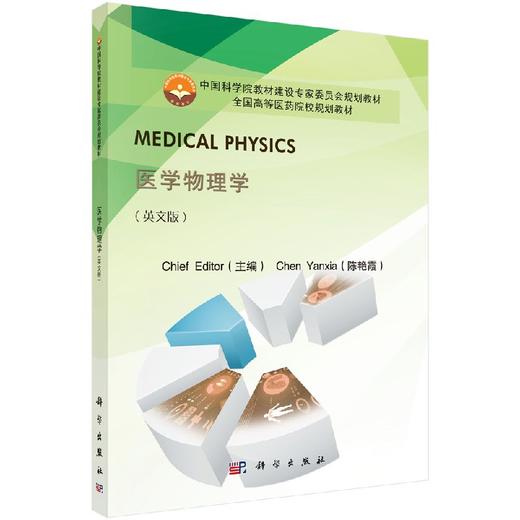
书名:医学物理学(英文版)
定价:55.0
ISBN:9787030425140
作者:陈艳霞
版次:3102
出版时间:2016-01
内容提要:
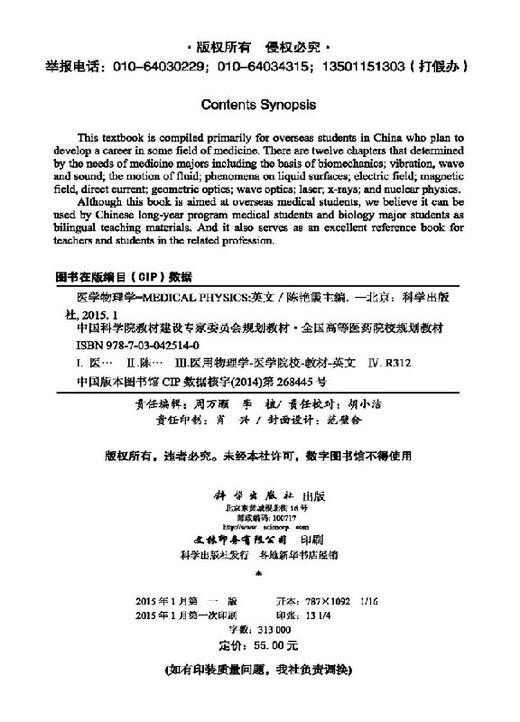
This textbook is compiled primarily for overseas students in China who plan to develop a career in some field of medicine. There are twelve chapters that determined by the needs of medicine majors including the basis of biomechanics; vibration, wave and sound; the motion of fluid; phenomena on liquid surfaces; electric field; magnetic field, direct current; geometric optics; wave optics; laser; x-rays; and nuclear physics.
媒体评论:
目录:
Preface CHAPTER 1 THE BASIS OF BIOMECHANICS 1 1.1 Newton’s Laws of Motion 1 1.2 Rotation of Rigid Bodies 2 1.3 Elastic Properties of Materials 7 1.4 The Mechanical Properties of Bone 10 1.5 The Mechanical Properties of Muscle 12 Summary 14 Review Questions 14 CHAPTER 2 VIBRATION, WAVE AND SOUND 16 2.1 Simple Harmonic Motion 17 2.2 The Combination of Vibration 22 2.3 Simple Harmonic Wave 28 2.4 Energy in Wave 32 2.5 Superposition of Wave and Interference 34 2.6 Sound Wave 37 2.7 Doppler Effect and Shock Wave 42 2.8 Ultrasonic and its Applications in Medicine 46 Summary 53 Review Questions 55 CHAPTER 3 THE MOTION OF FLUIDS 56 3.1 Steady Flow of Ideal Fluid 56 3.2 Bernoulli’s Equation 59 3.3 Applications of Bernoulli’s Equation 61 3.4 Viscous Fluid Flow 63 Summary 68 Review Questions 68 CHAPTER 4 PHENOMENA ON LIQUID SURFACES 70 4.1 Surface Tension and Surface Energy 70 4.2 Additional Pressure of a Curved Surface of Liquid 73 4.3 Capillary Action and Air Embolism 75 Summary 77 Review Questions 78 CHAPTER 5 STATIC ELECTRIC FIELD 79 5.1 Electric Field Intensity 80 5.2 Gauss’s Law 83 5.3 Electric Potential 88 5.4 Dielectrics 93 5.5 Electric Dipole and Membrane Potential 99 Summary 104 Review Questions 104 CHAPTER 6 MAGNETIC FIELD 106 6.1 Magnetic Field and Magnetic Induction 107 6.2 The Motion of a Charged Particle and the Force on a Current Wire in Magnetic Field 110 6.3 Magnetic Substance and Superconducting Magnet 118 6.4 Electromagnetic Induced Phenomena 121 6.5 The Applications of Magnetism in Biology 124 Summary 126 Review Questions 127 CHAPTER 7 DIRECT CURRENT 129 7.1 Electric Current and Electric Current Density 129 7.2 Kirchhoff’s Laws 131 7.3 Circuits Containing Resistor and Capacitor 135 7.4 The Applications of Direct Current in the Medicine 137 Summary 138 Review Questions 138 CHAPTER 8 GEOMETRIC OPTICS 140 8.1 Reflection and Refraction 140 8.2 Refraction at a Spherical Surface 142 8.3 The Thin Lens 146 8.4 The Eye 148 8.5 The Microscope 152 Summary 154 Review Questions 154 CHAPTER 9 WAVE OPTICS 156 9.1 Interference of Light 156 9.2 Diffraction of Light 161 9.3 Polarization of Light 163 Summary 169 Review Questions 169 CHAPTER 10 LASER 171 10.1 The Basis of Laser 171 10.2 The Bioeffects of Laser 175 10.3 The Application of Laser in Medicine 176 Summary 177 Review Questions 178 CHAPTER 11 X-RAYS 179 11.1 Generation of X-rays 179 11.2 X-rays Spectra 180 11.3 The Basic Properties of X-rays 184 11.4 The Absorption of X-rays 184 11.5 The Application of X-rays in Medicine 185 Summary 188 Review Questions 189 CHAPTER 12 NUCLEAR PHYSICS 190 12.1 The Properties of Nucleus 190 12.2 Nuclear Decay 193 12.3 The Rules of Nuclear Decay 194 12.4 The Interaction of Radiation with Matter 196 12.5 Radiation Detection and Measurement 198 12.6 The Applications of Radionuclide in Medicine 200 Summary 203 Review Questions 204 References 205 APPENDIX Fundamental Physical Constants 206
在线试读:
CHAPTER 1 THE BASIS OF BIOMECHANICS ? Newton’s Laws of Motion Newton’s First Law of Motion Newton’s Second Law of Motion Newton’s Third Law of Motion ? Rotation of Rigid Bodies Angular Displacement, Angular Velocity and Angular Acceleration Rotation of Rigid Bodies The Moment of Inertia ? Elastic Properties of Materials Stress Strain Modulus of Elasticity ? The Mechanical Properties of Bone Tensile and Compression Shear Torsion Bending Composite Load ? The Mechanical Properties of Muscle Elongate Pinch of Skeletal Muscle Equal Tensile Pinch of Skeletal Muscle Equal Length Pinch of Skeletal Muscle In this chapter, we will review Newton’s laws of motion, analyze the rotation of rigid body, discuss elastic properties of materials, and explore mechanical features of bone and muscle. 1.1 Newton’s Laws of Motion We know from experience that an object at rest never starts to move by itself. In order to move a body, a push or pull must be exerted on it by some other body. Similarly, a force is required to slow down or stop a body already in motion, and to make a moving body deviate from straight line motion requires a sideways force. All these processes (speeding up, slowing down, or changing direction) involve a change in either the magnitude or direction of the velocity. Thus in each case the body accelerates, and an external force must act on it to produce the acceleration. 1.1.1 Newton’s First Law of Motion Any object remains at rest or in motion along a straight line with constant speed unless acted upon by a net force (or resultant force ).This is Newton’s first law of motion(牛顿**运动定律). Newton’s first law describes the motion of an isolated object and there is no net force acting on it. In the most general case, a single force acting on a body produces a change in motion. However, when several forces act on a body simultaneously, their effects can compensate one another, with the result that there is no change in motion. When this is the case, the body is said to be in equilibrium. Mathematically, this means a=0, when Fnet=0.Where Fnet is the vector sum of all the forces acting on the body. This prop?erty of matter, that its motion will not change unless a net force acts on it, is what we call inertia(惯性). Inertia is the property of an object that resists accelera- tion. And Newton’s first law is often called the law of inertia(惯性定律). 1.1.2 Newton’s Second Law of Motion The product of the mass of any object times its acceleration is equal to the net force acting on the object . This is Newton’s second law of motion(牛顿第二运动定律). Fnet=ma (1.1) That is, if the sum of all forces acting on an object is not zero, then it will be accelerated. The acceleration depends on the net force and on the mass of the object as well. Notice that this equation says the acceleration is always in the same direction as the net force, although they are very different quantities. If you think of inertia as the qualitative term for the property of a body that resists acceleration, then mass (a scalar quantity) is the quantitative measure of inertia. If the mass is large, the acceleration produced by a given force will be small. 1.1.3 Newton’s Third Law of Motion For every force, or action, there is an equal but opposite force, or reaction. This is Newton’s third law of motion(牛顿第三运动定律). This law is true for any type of force, including frictional, gravitational, electrical, and magnetic forces. The important thing to realize about this law is that the action force is on one object and the reaction force is on the other. These two forces always act on different objects, so they can never balance each other, or cancel. Only when equal and opposite forces act on the same object can you add them together and then they do balance one another. So in a playground collision, the force on one child can’t cancel the force on the other. 1.2 Rotation of Rigid Bodies The rigid body(刚体), a body with a perfectly definite and unchanged shape regardless of the external force, is an idealized model. Therefore, the distance between any two points on a rigid body is always the same. Rotation(转动) of a rigid body, each point on the rigid body is in circular motion around the same straight line. This line is called the axis of rotation(转轴). If the axis of rotation is fixed, the rotation is called fixed-axis rotation(定轴转动). Fixed-axis rotation of rigid body is the most simple form of rotation. 1.2.1 Angular Displacement, Angular Velocity and Angular Acceleration We usually use angular displacement (角位移)q, angular velocity(角速度) w, angular acceleration (角加速度)a and other physical quantity to describe the rotation of rigid body. The relationship among them is as follows (1.2) For motion a circle, there is a simple relation between w and the velocity v along the circumference. As we know (1.3) Now differentiating the both sides with respect to t, we have So The velocity v is the distance traveled in one second. So is the number of revolution Therefore we have the very important relation between the frequency and the angular velocity (1.4) (1.5) The letter stands for frequency in revolution per second and w is radius per second. The acceleration The angular acceleration (1.6) So, we have (1.7) Obviously, the acceleration is the tangential acceleration. This relation is not only valid for the circular motion but also for any kind of curve motion. The only difference is the radius is changeable at different moment. 1.2.2 Rotation of Rigid Bodies For translational motion, we can find the acceleration from the forces using . For rotational motion, it is not the forces but the torques(力矩) exerted by these forces that determine the angular acceleration. Fig.1.1 shows a mass m at the end of a string swinging on a frictionless plane in a horizontal circle. The mass is subjected to two forces, the tension T in the string directed toward the center O , and the force Fa applied at right angles to the string. These two forces produce radial acceleration ar and tangential acceleration aT. The line of action of T passes through point O, so it produces no torque about that point and has no effect on the rotation. On the other hand, Fa does produce a torque M about point O. M=Far. From Newton’s second law, Fa=maT , and aT=ra. Thus the torque due to Fa can be written as . The quantity mr2 is the moment of inertia(转动惯量) I. The vector form of the torque equation is then (1.8) Fig.1.1 Torques For any object rotating about a fixed axis, the net torque on the object is equal to the moment of inertia of the object times the angular acceleration. This is the rotational version of Newton’s second law. 1.2.3 The Moment of Inertia Despite the fact that M=Ia is similar in form to Fnet=ma, it is important to realize that both the torque M and the moment of inertia I depend on the position of the axis of rotation. We will also find that I depend on the shape and mass of the rotating object. To calculate the moment of inertia of a complex object, we must mentally separate the object into N small pieces of mass m1, m2, …, mn. Then each piece is a distance r1, r2, …, rn from the axis of rotation. The moment of inertia of the first piece is , that of the second is , and so on. The net moment of inertia is the sum of all such terms (1.9) It is obvious that the moment of inertia is large when the pieces are far from the rotation axis. The calculation of the moment of inertia is illustrated in the following example. Example 1.1 Two equal point masses m are at the ends of a massless thin bar of length l ,as shown in Fig. 1.2.Find the moment of inertia for an axis, perpendicular to the bar through: ①the center, and ②an end. Fig.1.2 Example 1.1 Solution ①For an axis through the center, each mass is a distance l/2 from the axis. Summing the mr2 terms for each of the two masses, ②For an axis through an end, the mass at that end has r=0 , while the other mass is at a distance l, so we have Thus we see that the moment of inertia depends on the position of the rotation axis. The moment of inertia is often required for objects such as rods or cylinders whose mass is distributed in a continuous fashion. If this distribution is known in detail, then I can be calculated mathematically. In this case, Eq. (1.9) defining moment of inertia becomes (1.10) Where dm represents the mass of any infinitesimal particle of the body,and r is the perpendicular distance of the particle from the axis of rotation. The integral is taken over the whole body. This is easily done only for bodies of simple geometric shape. Some of the results obtained are listed in Table 1.1.
定价:55.0
ISBN:9787030425140
作者:陈艳霞
版次:3102
出版时间:2016-01
内容提要:
This textbook is compiled primarily for overseas students in China who plan to develop a career in some field of medicine. There are twelve chapters that determined by the needs of medicine majors including the basis of biomechanics; vibration, wave and sound; the motion of fluid; phenomena on liquid surfaces; electric field; magnetic field, direct current; geometric optics; wave optics; laser; x-rays; and nuclear physics.
媒体评论:
编辑推荐
暂无相关内容
目录:
Preface CHAPTER 1 THE BASIS OF BIOMECHANICS 1 1.1 Newton’s Laws of Motion 1 1.2 Rotation of Rigid Bodies 2 1.3 Elastic Properties of Materials 7 1.4 The Mechanical Properties of Bone 10 1.5 The Mechanical Properties of Muscle 12 Summary 14 Review Questions 14 CHAPTER 2 VIBRATION, WAVE AND SOUND 16 2.1 Simple Harmonic Motion 17 2.2 The Combination of Vibration 22 2.3 Simple Harmonic Wave 28 2.4 Energy in Wave 32 2.5 Superposition of Wave and Interference 34 2.6 Sound Wave 37 2.7 Doppler Effect and Shock Wave 42 2.8 Ultrasonic and its Applications in Medicine 46 Summary 53 Review Questions 55 CHAPTER 3 THE MOTION OF FLUIDS 56 3.1 Steady Flow of Ideal Fluid 56 3.2 Bernoulli’s Equation 59 3.3 Applications of Bernoulli’s Equation 61 3.4 Viscous Fluid Flow 63 Summary 68 Review Questions 68 CHAPTER 4 PHENOMENA ON LIQUID SURFACES 70 4.1 Surface Tension and Surface Energy 70 4.2 Additional Pressure of a Curved Surface of Liquid 73 4.3 Capillary Action and Air Embolism 75 Summary 77 Review Questions 78 CHAPTER 5 STATIC ELECTRIC FIELD 79 5.1 Electric Field Intensity 80 5.2 Gauss’s Law 83 5.3 Electric Potential 88 5.4 Dielectrics 93 5.5 Electric Dipole and Membrane Potential 99 Summary 104 Review Questions 104 CHAPTER 6 MAGNETIC FIELD 106 6.1 Magnetic Field and Magnetic Induction 107 6.2 The Motion of a Charged Particle and the Force on a Current Wire in Magnetic Field 110 6.3 Magnetic Substance and Superconducting Magnet 118 6.4 Electromagnetic Induced Phenomena 121 6.5 The Applications of Magnetism in Biology 124 Summary 126 Review Questions 127 CHAPTER 7 DIRECT CURRENT 129 7.1 Electric Current and Electric Current Density 129 7.2 Kirchhoff’s Laws 131 7.3 Circuits Containing Resistor and Capacitor 135 7.4 The Applications of Direct Current in the Medicine 137 Summary 138 Review Questions 138 CHAPTER 8 GEOMETRIC OPTICS 140 8.1 Reflection and Refraction 140 8.2 Refraction at a Spherical Surface 142 8.3 The Thin Lens 146 8.4 The Eye 148 8.5 The Microscope 152 Summary 154 Review Questions 154 CHAPTER 9 WAVE OPTICS 156 9.1 Interference of Light 156 9.2 Diffraction of Light 161 9.3 Polarization of Light 163 Summary 169 Review Questions 169 CHAPTER 10 LASER 171 10.1 The Basis of Laser 171 10.2 The Bioeffects of Laser 175 10.3 The Application of Laser in Medicine 176 Summary 177 Review Questions 178 CHAPTER 11 X-RAYS 179 11.1 Generation of X-rays 179 11.2 X-rays Spectra 180 11.3 The Basic Properties of X-rays 184 11.4 The Absorption of X-rays 184 11.5 The Application of X-rays in Medicine 185 Summary 188 Review Questions 189 CHAPTER 12 NUCLEAR PHYSICS 190 12.1 The Properties of Nucleus 190 12.2 Nuclear Decay 193 12.3 The Rules of Nuclear Decay 194 12.4 The Interaction of Radiation with Matter 196 12.5 Radiation Detection and Measurement 198 12.6 The Applications of Radionuclide in Medicine 200 Summary 203 Review Questions 204 References 205 APPENDIX Fundamental Physical Constants 206
在线试读:
CHAPTER 1 THE BASIS OF BIOMECHANICS ? Newton’s Laws of Motion Newton’s First Law of Motion Newton’s Second Law of Motion Newton’s Third Law of Motion ? Rotation of Rigid Bodies Angular Displacement, Angular Velocity and Angular Acceleration Rotation of Rigid Bodies The Moment of Inertia ? Elastic Properties of Materials Stress Strain Modulus of Elasticity ? The Mechanical Properties of Bone Tensile and Compression Shear Torsion Bending Composite Load ? The Mechanical Properties of Muscle Elongate Pinch of Skeletal Muscle Equal Tensile Pinch of Skeletal Muscle Equal Length Pinch of Skeletal Muscle In this chapter, we will review Newton’s laws of motion, analyze the rotation of rigid body, discuss elastic properties of materials, and explore mechanical features of bone and muscle. 1.1 Newton’s Laws of Motion We know from experience that an object at rest never starts to move by itself. In order to move a body, a push or pull must be exerted on it by some other body. Similarly, a force is required to slow down or stop a body already in motion, and to make a moving body deviate from straight line motion requires a sideways force. All these processes (speeding up, slowing down, or changing direction) involve a change in either the magnitude or direction of the velocity. Thus in each case the body accelerates, and an external force must act on it to produce the acceleration. 1.1.1 Newton’s First Law of Motion Any object remains at rest or in motion along a straight line with constant speed unless acted upon by a net force (or resultant force ).This is Newton’s first law of motion(牛顿**运动定律). Newton’s first law describes the motion of an isolated object and there is no net force acting on it. In the most general case, a single force acting on a body produces a change in motion. However, when several forces act on a body simultaneously, their effects can compensate one another, with the result that there is no change in motion. When this is the case, the body is said to be in equilibrium. Mathematically, this means a=0, when Fnet=0.Where Fnet is the vector sum of all the forces acting on the body. This prop?erty of matter, that its motion will not change unless a net force acts on it, is what we call inertia(惯性). Inertia is the property of an object that resists accelera- tion. And Newton’s first law is often called the law of inertia(惯性定律). 1.1.2 Newton’s Second Law of Motion The product of the mass of any object times its acceleration is equal to the net force acting on the object . This is Newton’s second law of motion(牛顿第二运动定律). Fnet=ma (1.1) That is, if the sum of all forces acting on an object is not zero, then it will be accelerated. The acceleration depends on the net force and on the mass of the object as well. Notice that this equation says the acceleration is always in the same direction as the net force, although they are very different quantities. If you think of inertia as the qualitative term for the property of a body that resists acceleration, then mass (a scalar quantity) is the quantitative measure of inertia. If the mass is large, the acceleration produced by a given force will be small. 1.1.3 Newton’s Third Law of Motion For every force, or action, there is an equal but opposite force, or reaction. This is Newton’s third law of motion(牛顿第三运动定律). This law is true for any type of force, including frictional, gravitational, electrical, and magnetic forces. The important thing to realize about this law is that the action force is on one object and the reaction force is on the other. These two forces always act on different objects, so they can never balance each other, or cancel. Only when equal and opposite forces act on the same object can you add them together and then they do balance one another. So in a playground collision, the force on one child can’t cancel the force on the other. 1.2 Rotation of Rigid Bodies The rigid body(刚体), a body with a perfectly definite and unchanged shape regardless of the external force, is an idealized model. Therefore, the distance between any two points on a rigid body is always the same. Rotation(转动) of a rigid body, each point on the rigid body is in circular motion around the same straight line. This line is called the axis of rotation(转轴). If the axis of rotation is fixed, the rotation is called fixed-axis rotation(定轴转动). Fixed-axis rotation of rigid body is the most simple form of rotation. 1.2.1 Angular Displacement, Angular Velocity and Angular Acceleration We usually use angular displacement (角位移)q, angular velocity(角速度) w, angular acceleration (角加速度)a and other physical quantity to describe the rotation of rigid body. The relationship among them is as follows (1.2) For motion a circle, there is a simple relation between w and the velocity v along the circumference. As we know (1.3) Now differentiating the both sides with respect to t, we have So The velocity v is the distance traveled in one second. So is the number of revolution Therefore we have the very important relation between the frequency and the angular velocity (1.4) (1.5) The letter stands for frequency in revolution per second and w is radius per second. The acceleration The angular acceleration (1.6) So, we have (1.7) Obviously, the acceleration is the tangential acceleration. This relation is not only valid for the circular motion but also for any kind of curve motion. The only difference is the radius is changeable at different moment. 1.2.2 Rotation of Rigid Bodies For translational motion, we can find the acceleration from the forces using . For rotational motion, it is not the forces but the torques(力矩) exerted by these forces that determine the angular acceleration. Fig.1.1 shows a mass m at the end of a string swinging on a frictionless plane in a horizontal circle. The mass is subjected to two forces, the tension T in the string directed toward the center O , and the force Fa applied at right angles to the string. These two forces produce radial acceleration ar and tangential acceleration aT. The line of action of T passes through point O, so it produces no torque about that point and has no effect on the rotation. On the other hand, Fa does produce a torque M about point O. M=Far. From Newton’s second law, Fa=maT , and aT=ra. Thus the torque due to Fa can be written as . The quantity mr2 is the moment of inertia(转动惯量) I. The vector form of the torque equation is then (1.8) Fig.1.1 Torques For any object rotating about a fixed axis, the net torque on the object is equal to the moment of inertia of the object times the angular acceleration. This is the rotational version of Newton’s second law. 1.2.3 The Moment of Inertia Despite the fact that M=Ia is similar in form to Fnet=ma, it is important to realize that both the torque M and the moment of inertia I depend on the position of the axis of rotation. We will also find that I depend on the shape and mass of the rotating object. To calculate the moment of inertia of a complex object, we must mentally separate the object into N small pieces of mass m1, m2, …, mn. Then each piece is a distance r1, r2, …, rn from the axis of rotation. The moment of inertia of the first piece is , that of the second is , and so on. The net moment of inertia is the sum of all such terms (1.9) It is obvious that the moment of inertia is large when the pieces are far from the rotation axis. The calculation of the moment of inertia is illustrated in the following example. Example 1.1 Two equal point masses m are at the ends of a massless thin bar of length l ,as shown in Fig. 1.2.Find the moment of inertia for an axis, perpendicular to the bar through: ①the center, and ②an end. Fig.1.2 Example 1.1 Solution ①For an axis through the center, each mass is a distance l/2 from the axis. Summing the mr2 terms for each of the two masses, ②For an axis through an end, the mass at that end has r=0 , while the other mass is at a distance l, so we have Thus we see that the moment of inertia depends on the position of the rotation axis. The moment of inertia is often required for objects such as rods or cylinders whose mass is distributed in a continuous fashion. If this distribution is known in detail, then I can be calculated mathematically. In this case, Eq. (1.9) defining moment of inertia becomes (1.10) Where dm represents the mass of any infinitesimal particle of the body,and r is the perpendicular distance of the particle from the axis of rotation. The integral is taken over the whole body. This is easily done only for bodies of simple geometric shape. Some of the results obtained are listed in Table 1.1.