自动软件检测预防 项目与过程管理实用途径 Automated Defect Prevention 英文原版
| 运费: | ¥ 0.00-16.00 |
| 库存: | 1 件 |
商品详情
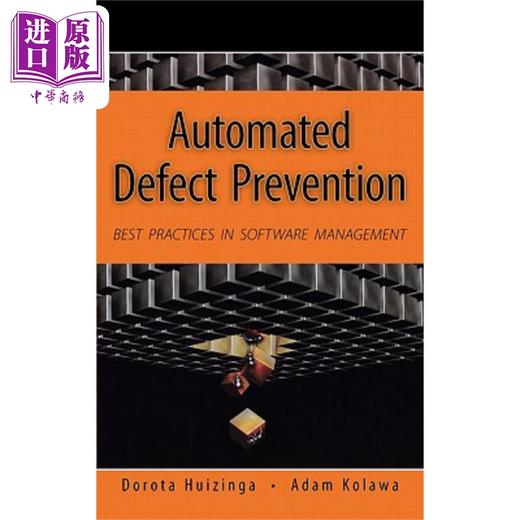
自动软件检测预防:项目与过程管理实用途径 Automated Defect Prevention: Best Practices In Software Management
基本信息
Series:IEEE Press
Format:Hardback 454 pages
Publisher:John Wiley & Sons Inc
Imprint:John Wiley & Sons Inc
ISBN:9780470042120
Published:9 Oct 2007
Weight:767g
Dimensions:243 x 162 (mm)
页面参数仅供参考,具体以实物为准
书籍简介
本书介绍了一种基于建立作为项目基础的基础设施的软件管理方法。这种基础设施定义了人的角色、必要的技术以及人与技术之间的互动。这种基础设施使重复性工作自动化,组织项目活动,跟踪项目状态,并无缝收集项目数据,为决策提供必要的措施。重要的是,这种基础设施维持并促进了人类定义的流程的改进。
书中所描述的方法被称为自动化缺陷预防(ADP),它在当前的软件领域中脱颖而出,因为它有两个独特的特点:它对缺陷预防的全面方法,以及它对自动化的深远强调。ADP是一个实施和管理软件项目和流程的实用而彻底的指南。它是一套通过过程改进进行软件管理的实践,通过这种灵活和适应性强的基础设施支持和维持的重复性任务的逐步自动化来实现,这种基础设施本质上形成了一条软件生产线。
在定义技术基础设施时,ADP描述了必要的功能,而不是具体的工具,因此保持了供应商的中立。只选择了对建立一个有效的基础设施至关重要的基本功能子集。许多现有的商业和非商业工具都支持这些功能,以及更高级的功能。附录E包含了这样一份清单。
This book describes an approach to software management based on establishing an infrastructure that serves as the foundation for the project. This infrastructure defines people roles, necessary technology, and interactions between people and technology. This infrastructure automates repetitive tasks, organizes project activities, tracks project status, and seamlessly collects project data to provide measures necessary for decision making. Most importantly, this infrastructure sustains and facilitates the improvement of human-defined processes.
The methodology described in the book, which is called Automated Defect Prevention (ADP) stands out from the current software landscape as a result of two unique features: its comprehensive approach to defect prevention, and its far-reaching emphasis on automation. ADP is a practical and thorough guide to implementing and managing software projects and processes. It is a set of best practices for software management through process improvement, which is achieved by the gradual automation of repetitive tasks supported and sustained by this flexible and adaptable infrastructure, an infrastructure that essentially forms a software production line.
In defining the technology infrastructure, ADP describes necessary features rather than specific tools, thus remaining vendor neutral. Only a basic subset of features that are essential for building an effective infrastructure has been selected. Many existing commercial and non-commercial tools support these, as well as more advanced features. Appendix E contains such a list.
作者简介
Dorota Huizinga博士是加州州立大学富勒顿分校工程和计算机科学学院的副院长和计算机教授。她的发表记录跨越了广泛的计算机科学学科,她的研究得到了国家科学基金会、加州州立大学系统和私营企业的赞助。
亚当-科拉瓦博士是Parasoft公司的联合创始人和首席执行官,该公司是自动防错软件解决方案的领先供应商。Kolawa博士是《Bulletproofing Web Applications》一书的共同作者,为100多篇评论文章和技术论文供稿或撰稿,并撰写了大量科学论文。
Dorota Huizinga, PhD, is the Associate Dean for the College of Engineering and Computer Science and Professor of Computer Science at California State University, Fullerton. Her publication record spans a wide range of computer science disciplines and her research was sponsored by the National Science Foundation, California State University System, and private industry.
Adam Kolawa, PhD, is the cofounder and CEO of Parasoft, a leading provider of Automated Error Prevention software solutions. Dr. Kolawa is a coauthor of Bulletproofing Web Applications, has contributed to or written more than 100 commentary pieces and technical papers, and has authored numerous scientific papers.
目录
部分目录,仅供参考
Preface.
Features and Organization.
Practice Descriptions.
Intended audience.
Acknowledgements.
Permissions.
Disclaimer.
1. The Case for Automated Defect Prevention.
1.1 What is ADP?
1.2 What are the goals of ADP?
1.2.1 People: Stimulated and Satisfied.
1.2.2 Product: High Quality.
1.2.3 Organization: Increased Productivity and Operational Efficiency.
1.2.4 Process: Controlled, Improved, and Sustainable.
1.2.5 Project: Managed through Informed Decision Making.
1.3 How is ASDP implemented?
1.3.1 Principles.
1.3.2 Practices.
1.3.3 Policies.
1.3.4 Defect Prevention Mindset.
1.3.5 Automation.
1.4 From the waterfall to modern software development process models.
1.5 Acronyms.
1.6 Glossary.
1.7 References.
1.8 Exercises.
2. Principles of Automated Defect Prevention.
2.1 Introduction.
2.2 Defect Prevention: Definition and Benefits.
2.3 Historical Perspective: Defect Analysis and Prevention in Auto Industry - What Happened to Deming?
2.4 Principles of Automated Defect Prevention.
2.4.1 Principle 1: Establishment of Infrastructure: "Build a strong foundation through integration of people and technology".
2.4.2 Principle 2: Application of General Best Practices: "Learn from others' mistakes".
2.4.3 Principle 3: Customization of Best Practices: "Learn from your own mistakes".
2.4.4 Principle 4: Measurement and Tracking of Project Status: "Understand the past and present to make decisions about the future".
2.4.5 Principle 5: Automation: "Let the computer do it".
2.4.6 Principle 6: Incremental Implementation of ADP's Practices and Policies.
2.5 Automated Defect Prevention based Software Development Process Model.
2.6 Examples.
2.6.1 Focus on Root Cause Analysis of a Defect.
2.6.2 Focus on Infrastructure.
2.6.3 Focus on Customized Best Practice.
2.6.4 Focus on Measurements of Project Status.
2.7 Acronyms.
2.8 Glossary.
2.9 References.
2.10 Exercises.
3. Initial Planning and Infrastructure.
3.1 Introduction.
3.2 Initial Software Development Plan.
3.2.1 Product.
3.2.2 People.
3.2.3 Technology.
3.2.4 Process.
3.3 Best Practices for Creating People Infrastructure.
3.3.1 Defining Groups.
3.3.2 Determining a Location for Each Group's Infrastructure.
3.3.3 Defining People Roles.
3.3.4 Establishing Training Program.
3.3.5 Cultivating a Positive Group Culture.
3.4 Best Practices for Creating Technology Infrastructure.
3.4.1 Automated Reporting System.
3.4.2 Policy for Use of Automated Reporting System.
3.4.3 Minimum Technology Infrastructure.
3.4.4 Intermediate Technology Infrastructure.
3.4.5 Expanded Technology Infrastructure.
3.5 Integrating People and Technology.
- 中商进口商城 (微信公众号认证)
- 中商进口商城中华商务贸易有限公司所运营的英美日韩港台原版图书销售平台,旨在向内地读者介绍、普及、引进最新最有价值的国外和港台图书和资讯。
- 扫描二维码,访问我们的微信店铺
- 随时随地的购物、客服咨询、查询订单和物流...